

Coaching IS: An Investment, NOT A Cost

Coaching is one of the most misunderstood tools in business and leadership. It’s often confused with consulting, mentoring, or even therapy or performance management. As a result, its real value and potential to transform people and conversations is overlooked.
As coaching becomes more common in organizational settings, leadership development, and professional and personal growth, it’s worth slowing down to clarify what coaching actually IS and just as importantly, what it IS NOT. This series is meant to bring nuance, realism, and clarity to the conversation, grounded in practical experience rather than hype. Because when coaching is understood properly, it can be a powerful support for how people think, lead, and work.
“Just as you wouldn’t hesitate to invest in marketing, technology, or staff development, you shouldn’t hesitate to invest in yourself as the owner and leader of your business.”
When business leaders, entrepreneurs, or professionals consider coaching, after deciding if they need it, they ask if they can afford it. It’s natural to look at the price tag and weigh it against other expenses. But here’s the critical distinction: coaching is not a cost. Coaching is an investment.
Costs drain resources. Investments generate returns.
Why We Confuse Investments with Costs
Responsible business owners monitor revenue and costs. Costs include “costs of goods (COGS)” and “operational costs.” Both are important lines on the Profit and Loss, and both help with decision-making.
Costs of Goods are those we pay (in a service-based business) for the service providers. Without these service providers, we have no revenue. These people are an INVESTMENT. Sure, you can find less-expensive service providers, and that improves your profit, maybe. If you pay too little for service providers, quality suffers, clients complain, reviews drop, and business suffers. If you pay too much for service providers, you don’t have enough profit to pay yourself or to keep the lights on.
Therefore, in a service-based business, I consider the providers an INVESTMENT. Some will pay off more than others, and it is important to know how much to invest.
I see coaching as a cost of goods. Under the same analogy, you can decide to pay more or less for your coach to tip profits, but a bad coach (like a bad provider) may do more harm than good. However, a good coach with observable returns that increase your success by 5-10X should be a “non-negotiable.” Like that good provider who brings you the most revenue or profit, is not someone you want to replace.
The other part of the “costs” equation are the operational costs that tend to be fixed. This might be an IT system, rent, utilities, bank charges, software, phones, social accounts, etc. Administrative support usually falls under here, but I would suggest some administrative personnel are also investments.
So, coaching fits in the analysis, but needs to be framed differently. Unlike most costs, coaching:
(Over time) produces measurable outcomes. Better decision-making, stronger leadership, improved efficiency.
(Over time) delivers value. The lessons, strategies, and clarity you gain extend far beyond the coaching relationship.
(Over time) impacts the whole business. A stronger leader creates stronger teams, systems, and results.
It’s like therapy, weight-loss, or the stock market. PATIENCE is key. Yes, eventually you may need to see the money spent as a sunk cost and make a different choice, but putting in the regular effort, and DOING the things coaching helps you to commit to, WILL WORK. You are not going to lose the 50 pounds in the first month or get a 10% return in the first week. But over the year? Success becomes obvious.
The True ROI of Coaching
So, what makes coaching an investment? Let’s look at the returns:
1. Better Decision-Making
With coaching, you gain clarity and frameworks for making confident choices.
Entrepreneurs stop spinning in indecision and start taking bold, strategic action.
Business leaders learn to weigh options against their values and long-term goals. Decisions made from this place of clarity stick.
2. Increased Productivity
Coaching helps you streamline priorities, eliminate distractions, and focus on what matters most.
A business owner might cut hours of wasted effort each week by redesigning workflows, delegating, or reducing distractions.
A team leader might create systems that reduce duplication and free up staff capacity.
3. Improved Leadership
Leadership isn’t about managing tasks; it’s about inspiring and guiding people. Coaching helps you to develop self-awareness, communication, and influence.
Healthcare managers lead more cohesive teams in often an environment of scarcity.
Corporate executives strengthen culture and employee engagement.
4. Financial Growth
When you make better decisions, save time, and lead effectively, revenue follows.
Entrepreneurs grow sustainably instead of reacting to fires.
Business owners increase profitability by spending time in an “entrepreneurial headspace” and aligning services with their true value.
The Risk of Viewing Coaching as a Cost
When coaching is seen as a cost, these things often happen:
It gets deprioritized. Leaders delay coaching until they feel “ready,” often when problems are already overwhelming.
It gets undervalued. If you see coaching as an expense, you miss the long-term impact it brings.
It creates scarcity. Every appointment, every conversation, you will be looking for immediate and obvious value. You will create stress on the coaching process, which will undermine its potential. It would be like hiring a personal trainer and weighing yourself after every session to see if it is still “worth it.”
This short-term mindset keeps businesses stuck in cycles of reaction instead of proactive growth. It creates chaos both in the mind of the owner and in the culture of the business.
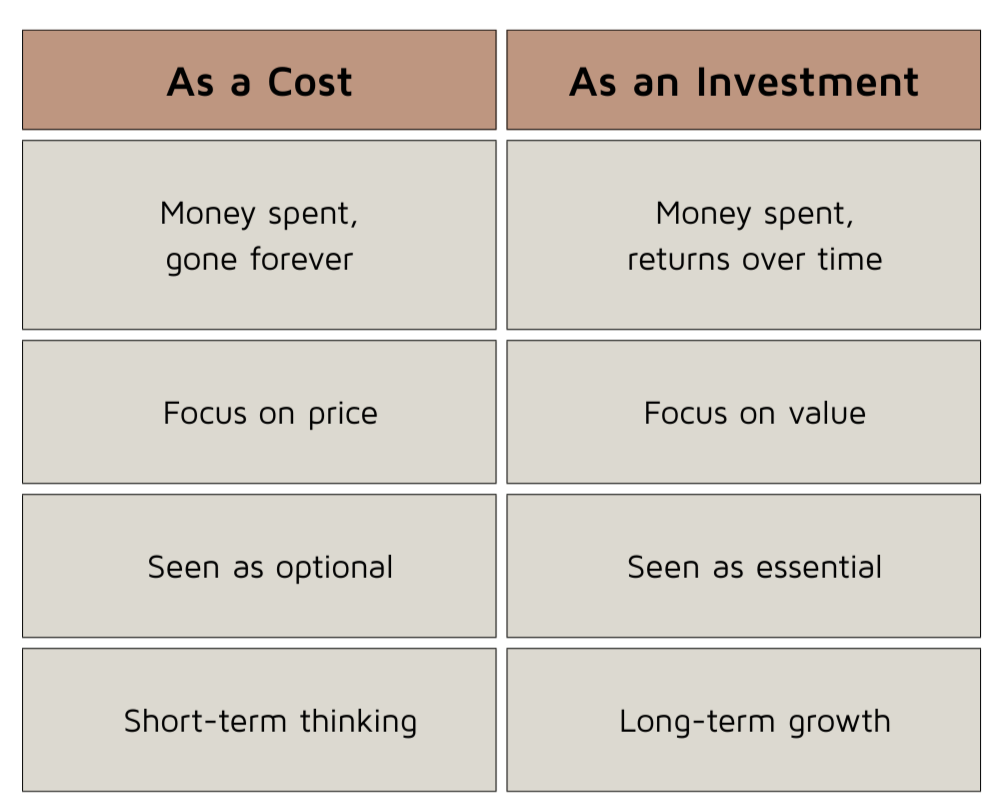
Short-Term Cost vs. Long-Term Value
Here’s how coaching compares when viewed through the right lens:
What You Really Buy When You Invest in Coaching
When you invest in coaching, you’re not buying hours with a coach. You’re buying:
Clarity on your goals and priorities.
Accountability to follow through.
Confidence in your decisions.
Perspective you can’t access on your own.
Tools and strategies that last far beyond the coaching sessions.
Partnership in helping you succeed.
Common Misconceptions
“Coaching is a luxury.”
Coaching isn’t a luxury; it’s a growth strategy.“I can figure it out on my own.”
Yes, you will. But when and at what cost? Mistakes, wasted time, and missed opportunities add up. If it takes you a year to get somewhere coaching will lead you in 3 months, that’s your choice.“I don’t have the budget.”
Budgets reflect priorities. If growth matters, coaching deserves a place. If you keep spending on that system that isn’t working, or that person that isn’t a fit, you are just using the budget in the wrong place.
Final Thoughts: Coaching Pays Dividends
Coaching, like all investment strategies, requires a commitment. Deciding to start, committing to a duration, and setting the budget aside gives you the optimal opportunity to receive the resulting dividends. The commitment should be at least 3 months, ideally 12. By 3 months, you will see gains, by 12, you will be thinking differently, feeling more confident, and making decisions without hesitation. Your metrics will have improved, and your clarity on the future of your business will be solidified.
Therefore, coaching is not a line item to cut when times are tight. It’s an investment that pays dividends in clarity, confidence, and growth. Just as you wouldn’t hesitate to invest in marketing, technology, or staff development, you shouldn’t hesitate to invest in yourself as the owner and leader of your business.
Because here’s the truth: the most valuable asset in your business is you. Investing in yourself is always money well spent. But truthfully? You are in business because you chose to bet on YOU. So, set yourself up for success and make YOU the main business development priority.
