


“Clients who respect your time, your expertise, and your process are easier to serve, more engaged, and more likely to refer you.”
When people talk about professionalism in business, especially in service-based industries, the conversation usually focuses on how we as business owners should behave: be reliable, communicate clearly, meet deadlines, follow through.
All of that matters, of course. But here’s what often gets left out of the conversation:
Professionalism should go both ways.
Respect in client relationships isn’t just something we give, it’s something we deserve. And if you’ve ever felt taken advantage of, undervalued, or walked over in your business, you’re not alone.
Whether you’re a coach, consultant, healthcare provider, or private practice owner, it’s time we normalize a balanced, mutually respectful dynamic between service provider and client.
This isn’t about being rigid or reactive. It’s about setting,and maintaining,a professional standard that honours both parties.
Why One-Sided Professionalism Doesn’t Work
You’ve probably had moments like these:
A client cancels last-minute, again.
Someone ghosts after a proposal, only to return three months later expecting the same rate and timeline.
You’re expected to reply to messages instantly, even after hours.
A client shows up late, unprepared, or distracted for a session, and still expects results.
These moments don’t just impact your mood or schedule; they chip away at your energy, your confidence, and your standards.
And when we keep absorbing this behaviour without naming it, we reinforce a culture where the service provider’s boundaries and time don’t matter.
That’s not the business you’re here to build.
Respect Is Part of Your Brand
As a business owner, you set the tone. You’re not just delivering a service; you’re building a container where both you and your clients can do great work.
That container is built on:
Clear expectations
Mutual accountability
Healthy communication
Shared respect
And guess what? When you lead with respect and require it in return, you actually create a better client experience. Clients feel safer, more engaged, and more empowered. You feel energized and committed.
Everybody wins.
Redefining Professionalism: What It Should Look Like
Let’s reframe professionalism in client relationships as a two-way exchange. Here’s what that looks like:
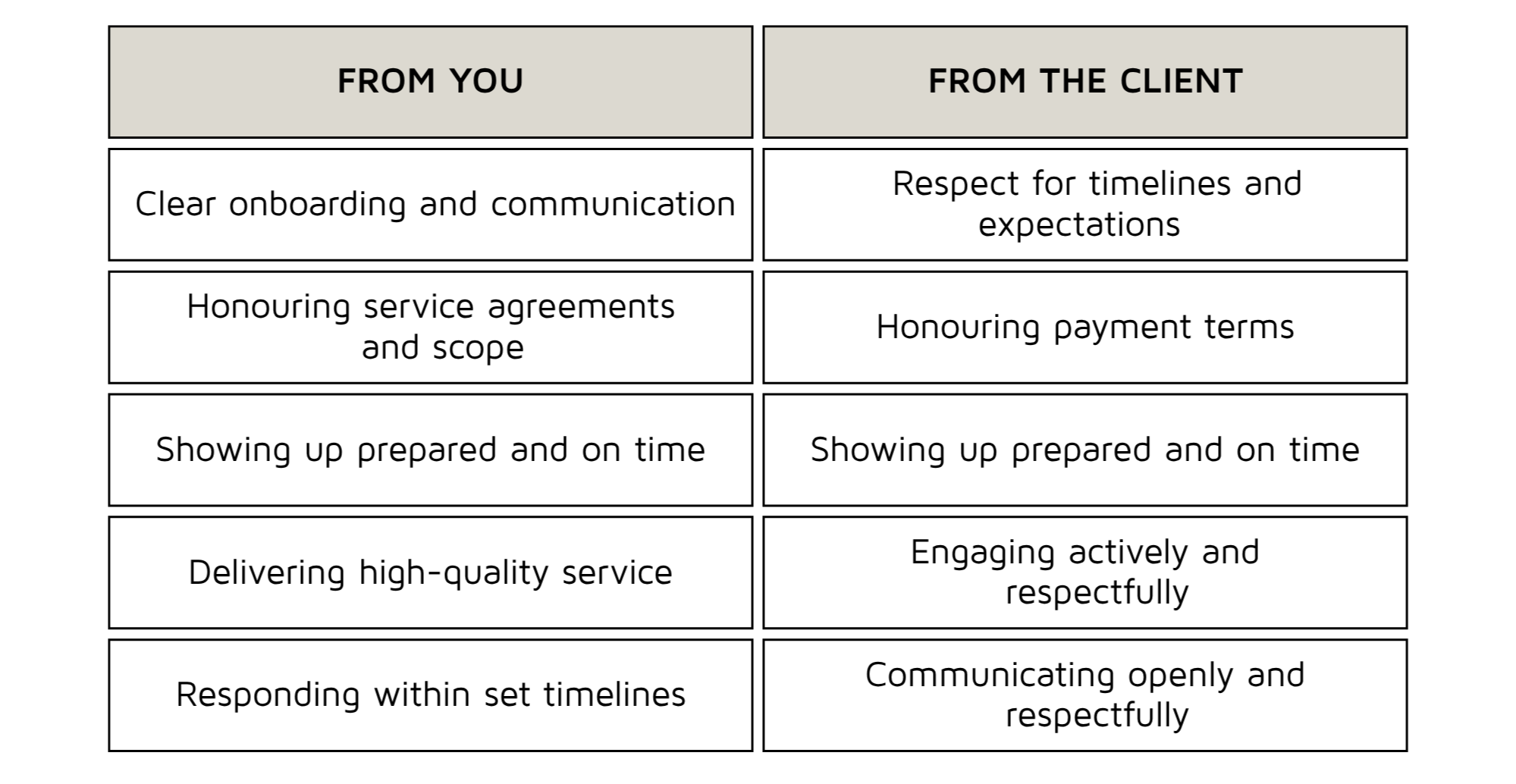
How to Set the Standard for Mutual Professionalism
So how do we make this the norm, not just the ideal? It starts with you.
Here are five key ways to set and protect a respectful, professional relationship with your clients:
1. Start With a Thoughtful Onboarding Process
Don’t leave expectations unspoken. Instead:
Provide a welcome package or onboarding document
Outline how you work, what’s included, and how to communicate
Explain what professionalism looks like in both directions
Pro tip: A clear contract is helpful, but a clear conversation is even better.
2. Reinforce Boundaries With Consistency
You don’t need to be strict to be professional; you need to be consistent.
That means:
Sticking to your policies on cancellations, rescheduling, and payments
Responding to late or no-show behaviour with clarity (not avoidance)
Modeling the communication style you want to receive
Every time you enforce your boundaries with kindness and clarity, you reinforce the culture of respect you’re building.
3. Have a Policy for Repeated Issues
Stuff happens. One late cancellation or awkward conversation isn’t a pattern. But when issues repeat, it’s time to address them.
Create internal guidelines for how you’ll respond, such as:
A warning after a second missed appointment
A conversation after consistent late payments
A change in service terms if respect isn’t mutual
Having a plan helps you respond professionally instead of reactively.
4. Model Respect in Every Interaction
Clients take cues from how you show up.
That means:
Responding calmly, even when you’re frustrated
Avoiding sarcasm, passive-aggressive comments, or guilt
Sticking to facts, agreements, and shared goals
Professionalism doesn’t mean you’re cold or distant. It means you’re steady and self-respecting.
5. Know When to Walk Away
Sometimes, despite your best efforts, a client relationship becomes unmanageable.
It’s okay to say:
“This isn’t working anymore, and I think we need to end the engagement.”
Ending a misaligned relationship isn’t failure; it’s leadership. You’re protecting your energy, your team, your time, and your brand.
Scripts for Addressing Client Disrespect
Here are a few ways to maintain professionalism without sacrificing firmness:
When a client is consistently late:
“I want to make the most of our time together, and I’ve noticed a pattern of late arrivals. Can we chat about what might help us start on time moving forward?”
When a client pushes boundaries:
“I want to be clear about what’s included in your package, so we can avoid misunderstandings. Here’s what’s included, and here’s what would be an additional service.”
When someone is disrespectful or inappropriate:
“I value professional and respectful communication. If that’s not possible, we may need to pause or end our work together.”
You Deserve Respect,Not Just Revenue
Let’s normalize something:
It’s okay to expect mutual professionalism.
It’s okay to decline or offboard clients who don’t honour your boundaries.
It’s okay to put your values before your invoices.
Being “nice” at the cost of your standards is not sustainable.
Being clear, direct, and values-aligned is what earns you long-term respect and referrals.
Final Thoughts: You Teach People How to Treat You
The way you communicate, deliver, and follow through in business is a teaching tool.
And so is the way you uphold your boundaries.
Clients who respect your time, your expertise, and your process are easier to serve, more engaged, and more likely to refer you.
You don’t need to over-explain your policies. You just need to enforce them with clarity and compassion.
Because at the end of the day, professionalism isn’t just about being polished.
It’s about protecting the kind of business and relationships you want to build.
